
Nuts, bolts and other threaded fasteners are essential components in machinery, vehicles, manufacturing equipment and countless mechanical assemblies. They provide a convenient way to connect components while allowing equipment to be dismantled when servicing or repairs are required.
However, threaded fasteners face an important challenge: vibration and repeated mechanical movement can gradually cause them to loosen.
A bolt that was correctly tightened during assembly may eventually lose clamping force when exposed to vibration, shock or changing operating conditions. Threadlocking adhesives provide an effective solution by filling the microscopic spaces between mating threads and helping prevent unwanted movement.
Medium-strength formulations are particularly useful because they offer dependable resistance to loosening while generally allowing fasteners to be removed with ordinary hand tools when maintenance is necessary.
What Is a Medium-Strength Threadlocker?
A threadlocker is a specialised adhesive designed for threaded metal components such as screws, bolts, studs and nuts.
Unlike a conventional adhesive that simply bonds two exposed surfaces together, many threadlocking products use anaerobic curing technology. The material remains liquid while exposed to air but begins curing when confined between closely fitted metal surfaces with oxygen excluded.
Once cured, the material fills spaces within the threaded connection and forms a strong polymer that helps prevent unwanted movement.
A product such as loctite 243 is a blue, medium-strength threadlocker designed to secure and seal metal nuts and bolts. It is intended to resist loosening caused by shock and vibration while retaining the possibility of disassembly with standard hand tools when servicing is required.
Why Do Nuts and Bolts Loosen?
A properly tightened bolt creates clamping force between the connected components. Under stable conditions, that connection can remain secure for a long period.
Real-world machinery, however, rarely operates under completely stable conditions.
Fasteners can experience repeated vibration from motors, engines, pumps, compressors and other moving equipment. Impact loads and mechanical shock can create additional stresses.
Temperature changes can also affect assemblies because materials expand when heated and contract as they cool.
Common factors contributing to loosening include:
- Continuous vibration
- Mechanical shock
- Repeated movement
- Thermal cycling
- Changing loads
- Component settling
Threadlocking compounds help address this problem directly at the threaded interface.
How Threadlockers Help Resist Vibration
Even when two threaded components appear to fit perfectly, microscopic spaces remain between their mating surfaces.
Liquid threadlocker flows into these spaces before curing.
After assembly, the adhesive cures within the threaded connection, helping prevent the small movements that can eventually allow a fastener to rotate and loosen.
This is particularly useful in machinery that experiences continuous vibration.
Rather than relying exclusively on tightening force, the assembly gains additional resistance through the cured material positioned throughout the threaded interface.
Why Medium Strength Is Useful
Threadlockers are available in different strength levels because not every mechanical assembly has the same requirements.
A permanent or high-strength formulation may be appropriate where disassembly is rarely expected. However, many machines require periodic maintenance.
Medium-strength threadlockers provide a useful balance.
They can secure threaded fasteners during normal operation while still allowing many assemblies to be dismantled using standard hand tools.
This characteristic makes them useful for equipment that needs both operational reliability and future serviceability.
Main Benefits of Threadlocking Adhesives
Protection Against Loosening
The primary benefit is resistance to loosening caused by shock and vibration.
This can improve the reliability of mechanical assemblies and reduce the need to repeatedly tighten troublesome fasteners.
Sealing the Threaded Connection
Because the liquid fills spaces between mating threads before curing, it can also help seal the connection.
This is an important difference from some traditional mechanical locking methods, which may prevent rotation without filling the threaded interface itself.
Corrosion Protection
Filling spaces between threads can help limit pathways through which moisture and contaminants reach internal threaded surfaces.
Reducing exposure to these substances can contribute to corrosion protection within the assembly.
Future Serviceability
Medium-strength products are particularly practical when machinery will eventually require servicing.
Fasteners can remain secure during operation without necessarily becoming permanently bonded.
Useful Oil Tolerance
Maintenance environments are not always perfectly clean.
Fasteners removed from industrial machinery may contain traces of oil or other operating fluids. Although appropriate surface preparation should always be performed according to product instructions, certain modern threadlockers are formulated to tolerate minor contamination.
This characteristic can make them particularly useful for maintenance and repair operations.
It should not be interpreted as a reason to ignore surface preparation. Excessive contamination can still affect adhesive performance, so technicians should follow the specified application procedure.
Common Industrial Applications
Threadlocking products are used throughout numerous industries because threaded fasteners are almost universal in mechanical equipment.
Pumps
Pumps frequently contain motors and moving components that produce vibration. Suitable threadlocking compounds can help maintain the security of threaded connections.
Gearboxes
Gearboxes operate under mechanical loads and continuous movement, making secure fastening important for reliable operation.
Manufacturing Machinery
Production equipment may operate for extended periods with repeated motion and vibration. Preventing fastener loosening can help reduce avoidable maintenance interruptions.
Automotive Assemblies
Vehicles contain numerous threaded components exposed to vibration, temperature changes and mechanical forces.
Appropriate threadlocking products may be used on suitable removable fasteners where additional resistance to loosening is required.
General Maintenance
Maintenance technicians frequently encounter screws, nuts and bolts that repeatedly work loose.
Using a suitable threadlocker during reassembly can provide a more effective solution than simply retightening the same fastener whenever it loosens.
Application and Surface Preparation
Correct application is essential for reliable performance.
Before applying a threadlocker, technicians should inspect the fastener and mating threads for damage or excessive contamination.
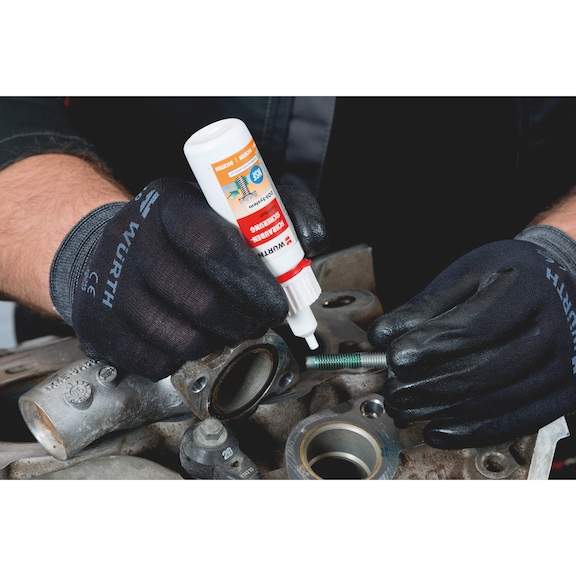
The product is then applied to the relevant threaded area according to its instructions before the components are assembled.
Users should pay attention to factors including:
- Fastener material
- Thread size
- Surface condition
- Required strength
- Operating temperature
- Cure time
- Future disassembly requirements
The adhesive should also be allowed sufficient time to cure before the assembly is subjected to its intended operating conditions.
Threadlockers Versus Mechanical Locking Devices
Traditional methods of preventing fastener movement include lock washers and other mechanical locking devices.
These solutions remain appropriate for many applications, but liquid threadlockers work differently.
Instead of adding another physical component to the assembly, the adhesive occupies spaces within the threads themselves.
This can provide vibration resistance while also offering sealing and corrosion-protection benefits.
The correct method should always be selected according to engineering requirements rather than assuming that one solution is suitable for every assembly.
Avoiding Common Mistakes
One common mistake is automatically selecting the strongest threadlocker available.
Greater strength is not always better. If equipment requires routine servicing, an unnecessarily high-strength product can make disassembly more difficult.
Other mistakes include applying too much material, failing to consider substrate compatibility and placing equipment into service before adequate curing has occurred.
Product specifications and technical instructions should therefore be reviewed before application.
Conclusion
Threaded fasteners provide a simple and effective method of assembling mechanical components, but vibration, shock and repeated movement can gradually compromise their security.
Medium-strength threadlocking adhesives provide a practical way to improve fastening reliability. By flowing into the microscopic spaces between mating threads and curing inside the connection, they help resist unwanted movement while providing additional sealing and corrosion protection.
Their combination of secure fastening and future serviceability makes them particularly useful for pumps, gearboxes, automotive components, manufacturing machinery and general maintenance.
Choosing the correct formulation, preparing the surfaces appropriately and allowing adequate curing time are all important. When used correctly, a medium-strength threadlocker can provide a straightforward way to protect threaded assemblies from vibration-related loosening without unnecessarily complicating future maintenance.