


The Core Dimensions of Sustainable Business Growth
Business growth, at its heart, is about more than just a rising top line. It’s a holistic expansion that touches every facet of an organization, building resilience and enhancing long-term value. We define sustainable growth through six interconnected dimensions: Revenue Growth, Market Expansion, Product Development, Operational Efficiency, Customer Acquisition and Retention, and Strategic Partnerships and Acquisitions. True growth requires a delicate balance across these areas, ensuring that increased sales don’t come at the expense of profitability or customer satisfaction.
A company might see its revenue increase, but if its operational costs spiral out of control, or if it fails to retain customers, that growth is unsustainable. Similarly, expanding into new markets without adequate product development or operational readiness can lead to significant setbacks. The goal is to create a virtuous cycle where each dimension reinforces the others, driving compound growth rather than isolated bursts of activity.
Organic vs. Inorganic Expansion Pathways
Companies typically pursue growth through two primary pathways: organic and inorganic.
Organic growth stems from internal efforts, leveraging existing resources and capabilities. This includes strategies like:
- Market Penetration: Increasing sales of current products or services to existing customers or similar customer segments. This often involves optimizing pricing, improving distribution, or intensifying marketing efforts.
- Product Development: Introducing new products or services to existing markets. Innovation and understanding evolving customer needs are crucial here.
- Market Development: Taking existing products or services to new markets, whether geographically or by targeting new customer demographics.
- A key aspect of organic growth, particularly in subscription-based models, is focusing on SaaS Expansion Revenue, ensuring customers grow with your offerings.
Inorganic growth, conversely, involves external activities such as mergers, acquisitions, and strategic alliances.
- Strategic Partnerships: Collaborating with other businesses to leverage complementary strengths, expand reach, or access new technologies.
- Programmatic Mergers and Acquisitions (M&A): Systematically acquiring other companies to gain market share, acquire talent, or diversify product lines. This approach can be highly effective, with research showing that programmatic acquirers often outperform organic growers. However, it requires careful planning and M&A Financial Readiness to ensure successful integration and value creation.
- Diversification: Entering entirely new markets with new products or services, often through acquisition, to reduce reliance on a single market or product line.
While organic growth typically accounts for the majority of a company’s expansion (around 80% from its core industry, according to McKinsey), inorganic strategies can provide rapid acceleration and access to new capabilities. The most successful companies often employ a blend of both, strategically choosing the pathway that best aligns with their growth objectives and market conditions.
Overcoming Common Obstacles to Business Growth
Despite the widespread desire for expansion, many businesses encounter significant hurdles. A striking statistic reveals that while 79% of small businesses express a desire for growth, only 41% actually experience it. This “growth gap” often stems from predictable obstacles that, if not addressed proactively, can halt momentum.
One common challenge is hitting “scaling walls”-points where initial growth plateaus due to underlying inefficiencies or a lack of strategic foresight. These walls often manifest as:
- Capacity Constraints: Operational bottlenecks, whether in production, service delivery, or administrative functions, can prevent a company from handling increased demand. Without scalable infrastructure and processes, growth can quickly lead to burnout and declining quality.
- Organizational Complexity: As teams grow, communication can break down, decision-making can slow, and bureaucracy can stifle innovation. Effective delegation, clear reporting structures, and strong leadership become paramount.
- Talent Gaps: The inability to attract, train, and retain skilled employees can severely limit a company’s capacity to expand. Growth demands specialized expertise that may not be readily available internally.
Overcoming these obstacles requires a commitment to continuous improvement and a reliance on data-driven insights. Companies that excel at growth often use sophisticated analytics to identify bottlenecks, optimize processes, and make informed decisions. Leveraging Data-driven business growth allows organizations to move beyond intuition, pinpointing areas for improvement and ensuring that resources are allocated effectively. It’s worth noting that fewer than half of companies excel at more than three of the ten rules of growth, and only 8 percent master more than five, underscoring the difficulty of navigating these challenges comprehensively. This highlights the need for a systematic approach to identifying and dismantling growth barriers.
Navigating the Stages of Organizational Scaling
Business growth is rarely a linear journey; it’s a dynamic process that unfolds in distinct stages, each presenting its own set of challenges and opportunities. Understanding these stages is crucial for anticipating needs and adapting strategies accordingly.
We typically observe four key stages in a company’s lifecycle:
- Startup Phase: Characterized by intense focus on product-market fit, securing initial customers, and simply surviving. Resources are often scarce, and decision-making is highly centralized, usually by the founder(s).
- Growth Phase: Rapid expansion of customer base and revenue. The primary focus shifts to scaling operations, building initial teams, and establishing foundational processes. This phase can be exhilarating but also fraught with cash flow strains and the need for significant investment.
- Expansion Phase: The company begins to explore new markets, diversify its product offerings, or open new locations. This stage demands more formalized management structures, effective coordination across growing teams, and careful strategic planning to avoid overextension.
- Maturity Phase: The company has established a stable market share and consistent revenue. The focus shifts towards optimizing efficiency, fostering continuous innovation to maintain competitive advantage, and potentially exploring renewal opportunities to avoid stagnation or decline.

The transition between these stages is often where companies falter. Research indicates that only one in three companies that were in the top quartile of growth between 2009 and 2014 managed to maintain that rate in the subsequent five-year period. This “reversion to the mean” underscores the difficulty of sustaining high growth without adapting strategies and structures to each new phase.
Managing Constraints at Each Development Stage
Each stage of growth brings unique constraints that demand tailored management approaches:
- Startup: The primary constraint is often a scarcity of capital and human resources. Founders are typically involved in every aspect of the business, leading to founder dependence. The focus here is on efficient resource utilization and proving the business model.
- Growth: Rapid growth can lead to significant cash flow challenges, as investments in inventory, marketing, and talent often outpace incoming revenue. Hiring and integrating new employees without diluting company culture also becomes a major hurdle. Proactive Operational Risks: 5 Questions to Ask Your Finance Team can help mitigate these issues.
- Expansion: Coordination across geographically dispersed teams or diverse product lines becomes a complex task. Effective delegation, standardizing processes, and implementing robust communication systems are essential to maintain cohesion and quality.
- Maturity: The risk here is complacency and a lack of innovation. Bureaucracy can set in, slowing decision-making and hindering adaptability. The challenge is to maintain an entrepreneurial spirit within a larger, more established organization.
Anticipating these constraints and developing strategies to manage them is a hallmark of successful, sustainable growth. It requires a flexible organizational structure and a leadership team capable of evolving with the business.
Balancing Short-Term Performance with Long-Term Value
A critical balancing act for any growing company is managing the tension between achieving short-term performance targets and making strategic investments that build long-term value. This often involves difficult decisions about resource allocation and prioritizing initiatives.
Companies that successfully navigate this balance understand that short-term wins can fuel long-term ambitions, but an exclusive focus on immediate results can jeopardize future potential. For instance, an extra five percentage points of revenue per year correlates with an additional three to four percentage points of total shareholder returns (TSR)-the equivalent of increasing market capitalization by 33 to 45 percent over a decade. This highlights the profound impact of sustained growth on long-term value.
Key strategies for achieving this balance include:
- Strategic Resource Reallocation: This involves the willingness to “shrink to grow,” as McKinsey research suggests. It means ruthlessly pruning underperforming or stagnant parts of the business portfolio and reallocating those resources to high-growth, high-potential areas.
- Prioritizing Core vs. Adjacent Opportunities: While “turbocharge the core” business-optimizing and investing in existing strengths-companies must also look beyond to adjacent markets or capabilities. This allows for diversification without straying too far from established expertise.
- Portfolio Pruning: Regularly assessing all business units, product lines, and investments for strategic fit and profitability. Divesting non-core or underperforming assets frees up capital and management attention for more promising ventures.
- Focusing on Value-Creating Growth: Not all growth is equal. Companies that manage to grow faster and more profitably than their peers generate shareholder returns six percentage points above their industry averages. This emphasizes the importance of profitable growth over mere top-line expansion.
This strategic agility ensures that the company remains competitive and continues to create value, even in uncertain economic environments.
Financial Leadership: The Engine of Scalable Expansion
At the heart of sustainable business growth lies robust financial leadership. It’s not just about managing money; it’s about strategic capital allocation, understanding unit economics, and preparing for the future through meticulous scenario planning and risk mitigation. A strong financial function transforms raw data into actionable insights, guiding every growth decision.
Effective financial leadership ensures that:
- Capital Allocation is optimized, directing funds to initiatives that promise the highest return on investment and align with long-term strategic goals.
- Unit Economics are thoroughly understood, ensuring that each product, service, or customer segment is profitable at scale. This insight prevents companies from growing unprofitable segments, which can be a significant drain on resources.
- Scenario Planning is an ongoing practice, allowing the business to model various market conditions and their potential financial impacts. This proactive approach helps in preparing for both opportunities and downturns. For a deeper dive, exploring Scenario vs Sensitivity Analysis can be highly beneficial.
- Risk Mitigation strategies are in place, identifying potential financial vulnerabilities associated with growth, such as increased debt, liquidity issues, or market volatility.
Strategic Budgeting and Forecasting Models
Beyond traditional accounting, strategic budgeting and forecasting are dynamic tools essential for navigating growth. They provide the financial roadmap for expansion, allowing businesses to anticipate needs and make informed decisions.
- Growth cash flow forecasting is particularly critical during periods of rapid expansion. It helps businesses manage liquidity, ensuring they have sufficient working capital to fund increased operations, inventory, and marketing efforts. This is a continuous process that needs to be refined as the business evolves.
- Sensitivity Analysis moves beyond static forecasts by testing how changes in key assumptions (e.g., sales volume, raw material costs, interest rates) impact financial outcomes. This helps in understanding the resilience of the business model and identifying critical variables.
- Working Capital Management becomes increasingly important as a business scales. Efficiently managing current assets and liabilities ensures that the company can meet its short-term obligations while investing in growth.
- Capital Structure Optimization involves finding the right mix of debt and equity financing to support growth without overburdening the company with excessive interest payments or diluting ownership unnecessarily.
For complex financial planning and strategic direction, many growing companies benefit from the expertise of a Financial Modeling Consultant in Business Strategy. Furthermore, a comprehensive Strategic Finance Guide can provide invaluable frameworks for navigating these complexities.
Measuring Long-Term Success Metrics
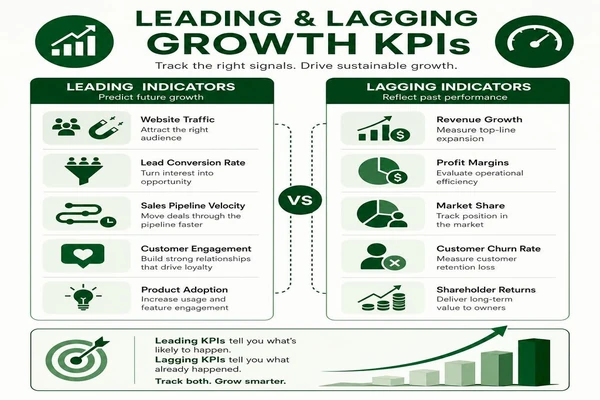
To truly understand if growth is sustainable and value-creating, companies must look beyond superficial metrics. While revenue growth is important, it’s the underlying indicators that reveal long-term health and potential. We differentiate between leading and lagging indicators:
- Leading Indicators are forward-looking metrics that predict future performance (e.g., website traffic, lead conversion rates, sales pipeline velocity, customer engagement).
- Lagging Indicators are backward-looking metrics that measure past performance (e.g., revenue growth, profit margins, market share, customer churn rate, shareholder returns).
Key metrics for measuring long-term success include:
- Customer Lifetime Value (CLV): The total revenue a business can reasonably expect from a single customer account over their relationship. A high CLV indicates strong customer retention and satisfaction.
- Customer Acquisition Cost (CAC): The cost associated with convincing a prospective customer to buy a product or service. Balancing CLV with CAC is crucial for profitable growth.
- Net Revenue Retention (NRR): Especially vital for SaaS and subscription-based businesses, NRR measures the percentage of recurring revenue retained from existing customers over a specific period, including upgrades, downgrades, and churn. Understanding Net Revenue Retention SaaS 101 is key for these models.
- Rule of 40: A benchmark for SaaS companies, suggesting that a company’s revenue growth rate plus its profit margin should equal or exceed 40%. This helps balance growth with profitability, informing Rule of 40 Valuation Planning.
These metrics contribute to the overall Business Valuations of a company, reflecting its ability to generate future cash flows and create shareholder wealth. Continuously monitoring and improving these metrics is essential for increasing Business Value with Smarter Financial Reporting.
Digital Marketing Strategies That Compound Revenue
In today’s digital-first landscape, effective marketing is no longer just about generating activity; it’s about building systems that compound revenue. Many businesses measure growth the wrong way, focusing on vanity metrics like calls booked or content pieces shipped, which can lead to busy teams but flat revenue. The goal is to move beyond mere activity to strategies that create exponential, sustainable growth.
Modern digital marketing for growth focuses on:
- Strategic Customer Acquisition: Moving beyond broad campaigns to highly targeted efforts that attract ideal customers with a high propensity to convert and retain.
- Strong Brand Positioning: Clearly articulating the unique value proposition and differentiating the business in a crowded market to build trust and loyalty.
- Optimized Sales Funnel Architecture: Designing a seamless customer journey from initial awareness through to advocacy, ensuring minimal friction and maximum conversion at each stage.
- Continuous Conversion Optimization: Relentlessly testing and refining every element of the marketing and sales process to maximize the percentage of prospects who complete desired actions.
Leveraging Technology and AI for Business Growth
Technology, particularly Artificial Intelligence (AI) and automation, has become a force multiplier for businesses aiming for accelerated growth. These tools allow companies to achieve more with fewer resources, making their systems work harder than their people.
- Agentic AI: Beyond simple chatbots, agentic AI refers to autonomous AI systems capable of performing complex, multi-step tasks and workflows. These agents can manage lead qualification, customer service inquiries, or even parts of content generation, freeing up human teams for higher-value activities.
- Automated Lead Scoring: AI-powered systems can analyze vast amounts of data to automatically score and prioritize sales leads based on their likelihood to convert. This ensures sales teams focus their efforts on the most promising prospects, dramatically improving efficiency.
- Workflow Efficiency: Automation streamlines repetitive marketing and sales tasks, from email nurturing sequences to data entry, reducing manual effort and minimizing errors. This allows teams to scale operations without proportionally increasing headcount.
- RevOps Integration: Revenue Operations (RevOps) aligns sales, marketing, and customer service teams around a unified strategy, shared data, and common goals. Technology, especially CRM and marketing automation platforms, facilitates this integration, creating a seamless customer experience and a single source of truth for revenue data.
AI leaders are not just innovating; they are outperforming. Research shows that AI leaders achieve 1.7 times higher revenue growth and produce 3.5 times more patents than non-AI companies, underscoring the transformative power of these technologies.
Content Engines and Performance Marketing
To truly compound revenue, digital marketing must build assets that continue to generate value over time, rather than relying on one-off campaigns.
- Content That Compounds: This involves creating evergreen, high-quality content (e.g., video-first content, comprehensive guides, deep-dive articles) that addresses core customer pain points and continuously attracts organic traffic and leads. Unlike disposable social media posts, this content builds authority and relevance over months and years. For example, a single well-produced YouTube video can generate hundreds of organic views per month for 18+ months.
- Search Engine Optimization (SEO) & Generative Engine Optimization (GEO): A strong SEO strategy ensures visibility in traditional search results. As AI-powered generative search becomes more prevalent, Generative Engine Optimization (GEO) focuses on optimizing content to be easily discoverable and utilized by AI models for summarization and direct answers. These are not competing strategies but rather layers of a single system for maximum digital presence.
- Multi-Touch Attribution: Moving beyond simplistic “last-click” attribution, multi-touch models provide a more accurate understanding of the entire customer journey. They attribute credit to all touchpoints (e.g., social media, blog post, email, paid ad) that influenced a conversion, allowing for more informed budget allocation.
- Performance Marketing: This approach focuses on measurable results and return on investment (ROI). Every marketing dollar is traceable, with a strong emphasis on metrics like Return on Ad Spend (ROAS), Customer Acquisition Cost (CAC), and payback period. This data-driven discipline ensures that marketing spend directly contributes to revenue growth.
Frequently Asked Questions about Business Growth
What is the difference between scaling and growing a business?
While often used interchangeably, “growing” and “scaling” a business have distinct meanings, particularly in the context of financial efficiency and resource utilization.
- Growing a business typically implies a linear increase in revenue and customer base, often accompanied by a proportional increase in resources and costs. For example, if you double your sales, you might also need to double your staff, office space, and operational expenses. Growth is about expansion, but not necessarily with improved efficiency.
- Scaling a business, on the other hand, means achieving an exponential increase in revenue and customer base with a less than proportional increase in resources and costs. The goal of scaling is to maximize exponential efficiency and resource leverage. A scalable business model can handle significantly more volume without a corresponding rise in expenses. This is achieved through automation, standardized processes, technology adoption, and strategic partnerships.
Both growth and scaling involve revenue growth, but scaling emphasizes achieving that growth with greater cost predictability and higher profit margins, making it a more sustainable and attractive long-term strategy.
How does AI accelerate sustainable business expansion in 2026?
In June 2026, Artificial Intelligence (AI) is no longer a futuristic concept but a practical tool driving significant business expansion. It accelerates growth through several key mechanisms:
- Automation: AI automates repetitive, time-consuming tasks across various departments-from customer service chatbots handling routine inquiries to AI-powered tools generating marketing copy or analyzing data. This frees up human capital to focus on strategic, high-value activities.
- Predictive Analytics: AI algorithms can analyze vast datasets to identify patterns, forecast market trends, predict customer behavior, and anticipate potential risks with remarkable accuracy. This enables businesses to make proactive, data-driven decisions regarding product development, market entry, and resource allocation.
- Cost Reduction: By optimizing processes, reducing manual errors, and enhancing efficiency, AI directly contributes to cost savings. These savings can then be reinvested into further growth initiatives, creating a virtuous cycle of efficiency and expansion.
- Decision Speed: AI provides real-time insights and recommendations, significantly accelerating the decision-making process. Leaders can respond more quickly to market shifts, competitive threats, and emerging opportunities, maintaining agility in an environment.
Overall, AI acts as a strategic partner, enabling businesses to operate more intelligently, efficiently, and with greater foresight, making sustainable expansion more attainable.
Why do most mid-market companies hit a growth wall?
Mid-market companies (typically those with revenues between $5 million and $50 million) often encounter a “growth wall” where their initial momentum stalls. This phenomenon is common and can be attributed to several factors:
- Increased Complexity: As a company grows, its operations, organizational structure, and customer relationships become exponentially more complex. The informal systems that worked during the startup phase are no longer sufficient, leading to inefficiencies and breakdowns.
- Lack of Strategic Planning: Many companies fail to adapt their strategic planning to their new stage of growth. What worked for a small team won’t work for a larger organization. A reactive approach, rather than a proactive, long-term strategy, often leads to stagnation.
- Operational Bottlenecks: Inadequate infrastructure, outdated technology, or inefficient processes can severely limit a company’s capacity to handle increased demand. These operational bottlenecks prevent scaling and can lead to customer dissatisfaction.
- Talent Gaps: The transition from a small business to a mid-market leader requires specialized talent in areas like senior management, finance, marketing, and operations. Failure to attract, retain, or develop this critical talent can leave leadership teams stretched thin and unable to execute growth strategies effectively.
- Cash Flow Challenges: Rapid growth often consumes cash faster than it generates it, especially if profitability isn’t managed alongside revenue. Without sophisticated growth cash flow forecasting and capital management, even profitable companies can face liquidity crises.
Overcoming these growth walls requires a deliberate shift from entrepreneurial improvisation to structured, strategic management, often involving significant investment in systems, talent, and financial oversight.
Conclusion
The journey of business growth in June 2026 is an intricate dance of ambition, strategy, and execution. As we’ve explored, true growth transcends mere revenue increases, demanding a holistic approach that balances organic and inorganic pathways, navigates distinct developmental stages, and leverages the power of financial leadership and digital innovation.
The path to sustainable expansion is rarely smooth, marked by inevitable challenges and “growth walls.” However, by embracing strategic agility, committing to continuous planning, and prioritizing execution excellence, businesses can transform these obstacles into opportunities. Integrating robust financial oversight, including meticulous forecasting and capital allocation, alongside cutting-edge digital marketing strategies that compound revenue, forms the bedrock of this success. The goal is to build long-term value, creating resilient enterprises that not only thrive in the present but are also strategically positioned for enduring prosperity.